You knew exactly
what you needed to do.
You just couldn't start.
You'd been thinking about it all morning. You sat down, opened your laptop, and then something happened that you still can't fully explain.
An hour passed. Maybe two. The task was still there. You were still there. And somewhere between the sitting down and the not starting, a familiar voice said the thing it always says:
"What is wrong with you?"
Nothing is wrong with you. But something is wrong with the system you've been handed.
Do More In A Day is a $27 masterclass built specifically for the ADHD brain - a complete personal operating system that replaces shame-driven willpower with a structure your neurology can actually use.
I want to tell you something, and I need you to know I'm not guessing.
You are not lazy. You know this, intellectually, because lazy people don't lie awake at midnight mentally rehearsing tomorrow's to-do list with the intensity of someone planning a moon landing. Lazy people don't feel the specific, suffocating guilt of watching a deadline approach while being completely unable to move toward it. Lazy people don't care this much.
You care enormously. That's part of what makes this so hard.
You wake up with intention. Today is different. You have the list. You have the plan. You might have even laid out your workspace the night before, which felt productive in itself — a small, hopeful act of preparation. You sit down. You open the thing. And then... the wall appears.
It's not procrastination in the way people mean when they say that word. It's not that you'd rather be doing something else. It's that there is a physical, neurological barrier between you and the task that no amount of knowing-you-should-do-it seems to dissolve. You sit with it. You try to push through it. You open a different tab — not because you want to, but because your brain has gone looking for something, anything, that will generate enough stimulation to get the engine running.
And then the shame arrives. Right on schedule.
It stopped working because it was never built for your brain.
You are not a broken version of a neurotypical person. You are a different kind of brain operating inside systems designed by and for people who don't share your neurology. That's not a consolation. That's a diagnosis. And diagnoses point toward solutions.
I wrote this for the version of you who has almost stopped hoping — who will read this page with one eye open and one eye protected, because you've been here before and you know what it feels like when something doesn't work. I'm not asking you to believe yet. I'm just asking you to keep reading.
The wall is not a character flaw.
It has a name, a mechanism,
and a workaround.
Here is what is actually happening when you sit down to work and can't begin:
The ADHD brain has a fundamentally different relationship with dopamine — the neurotransmitter that drives motivation, initiation, and follow-through. In a neurotypical brain, the anticipation of completing a task generates enough dopamine to initiate action. The brain essentially pre-rewards itself for starting. In the ADHD brain, that pre-reward system is significantly underactive. The task sits there, objectively important, while your brain waits for a dopamine signal that isn't coming through the usual channels.
This is not weakness. This is not poor character. This is not something that more discipline or more shame will fix — because discipline and shame are motivational tools, and motivation is precisely the system that is wired differently in your brain.
Every productivity system you've tried that failed you was built on the assumption that motivation is a character resource you can develop through habit and willpower. For a neurotypical brain, that's partially true. For your brain, it's like being told that if you just tried harder, your nearsightedness would correct itself.
You don't need more willpower.
You need glasses.
A person with poor vision doesn't fail at seeing because they lack discipline. They fail at seeing because they're using the wrong tool. The moment they get the right tool — the one that accounts for the actual structure of their eye — seeing becomes effortless. Not because they changed. Because the tool finally matched the hardware.
That is what this is about. Not fixing you.
Matching the tool to the hardware you already have.
When you stop trying to override your neurology and start working with it — when you build your environment, your energy management, your task structure, and your self-permission framework around how your brain actually generates momentum — the wall doesn't disappear dramatically. It just... stops being the default. Starting becomes something that can happen. And that changes everything.
The mechanism is real. The workaround is learnable. The system exists.
I'm not going to promise you
transformation.
You've been sold transformation before and it didn't land, and I respect you too much to do that to you again.
Here is what I want to offer you instead: the specific, small, real experience of sitting down on a Tuesday morning — no different from any other Tuesday — and beginning.
Not because you finally found the motivation. Not because the stakes got high enough to force you into action. Not because you had a breakthrough or a revelation or a particularly inspiring podcast episode. Just… beginning. Because the conditions were right. Because the environment was set up the way your brain needs it. Because you'd eaten and moved and structured your morning in a way that actually generates the neurological conditions for initiation. Because you gave yourself permission to start imperfectly instead of waiting for the version of starting that never comes.
Not a new you. Not a productivity superhero. Just a Tuesday where the work gets done. And then another one. And then the slow accumulation of weeks where you are, for the first time, roughly keeping pace with what you know you're capable of.
- The intelligence
- The ideas
- The desire
- A structure that lets all of that actually move
Until now.
That's what we're going to build.
Introducing
Do More In A Day
A Complete Personal Operating System for the ADHD Brain
One-time investment
$27
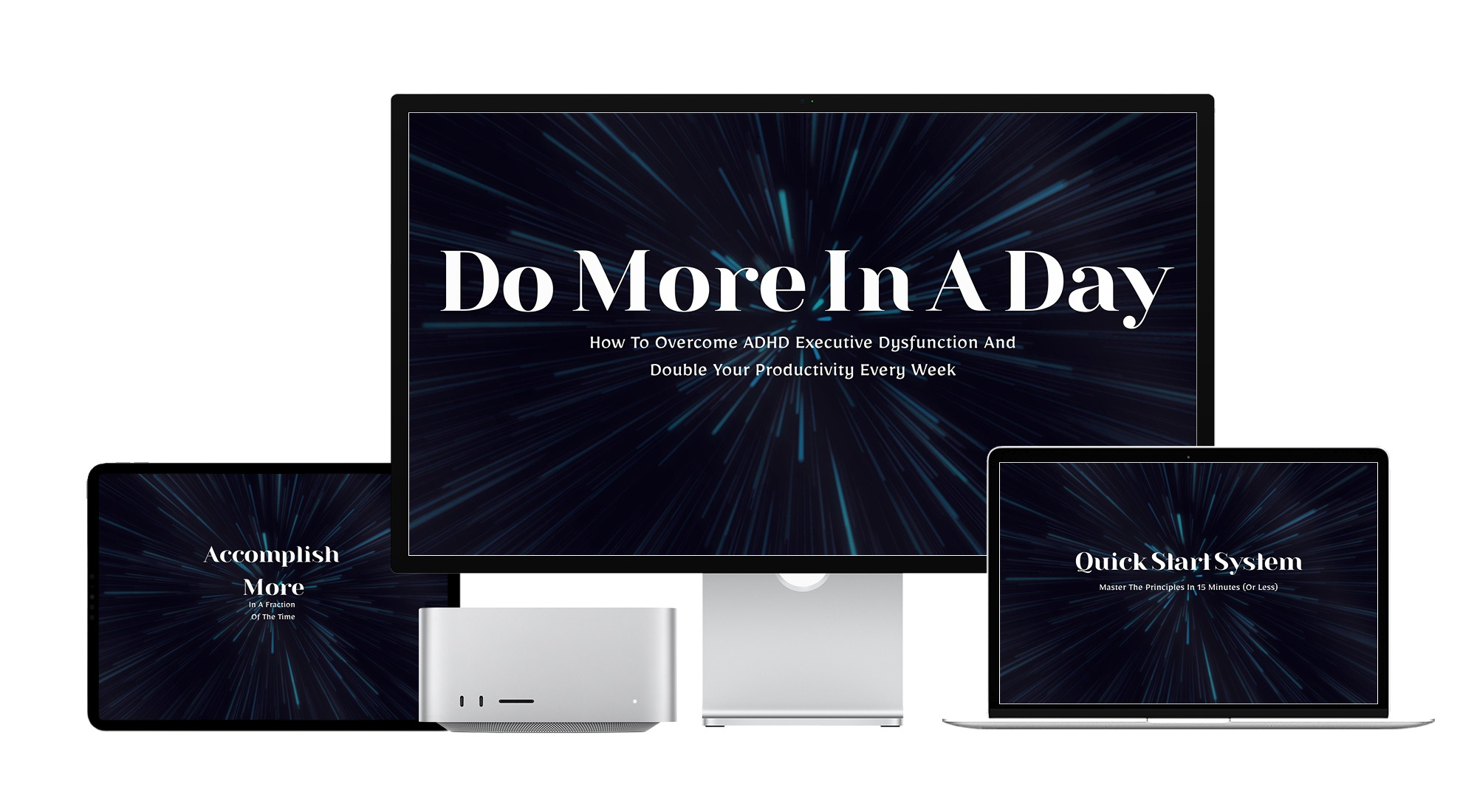
This is not a collection of tips. It is not a productivity hack compilation. It is not another planner system dressed up in new language.
Do More In A Day is a structured masterclass — built from the ground up for neurodivergent brains — that gives you a complete, integrated operating system for how you work, rest, initiate, sustain, and recover. Every component was designed with one question in mind: does this account for how the ADHD brain actually functions, or does it assume neurotypical defaults?
The ADHD-Specific Morning Protocol
A step-by-step morning structure built entirely around generating the neurological conditions for a productive day — before you sit down to work. Not a morning routine. A neurological warm-up.
The "Stuck Right Now" Emergency Toolkit
What to do in the specific moment when you've been sitting at your desk for forty minutes and nothing is happening. Five evidence-based, ADHD-specific re-entry techniques that work without requiring motivation you don't have.
Everything is delivered in clear, direct video and written format. No fluff. No filler. No content that exists to make the course feel longer.
One-Time Investment
6 modules + 2 bonuses — immediate lifetime access
Built for your brain. Not borrowed from someone else's.
What You'll Be
Able To Do
Here is what changes — not in some abstract future, but on a specific morning in the next few weeks:
You sit down to work and you have a sequence. Not a to-do list that stares back at you with silent judgment, but an actual launch sequence — a set of environmental and neurological conditions you've built that your brain recognizes as the signal to begin. You follow the sequence. You begin. It is not magical. It is just... functional. That alone is worth more than you can currently calculate.
You stop losing entire days to the gap between knowing and doing. The gap doesn't vanish, but it shrinks from hours to minutes. You have tools for it now — specific, tested, ADHD-compatible tools — instead of just willpower and self-recrimination.
You stop scheduling your hardest work at 9am because that's when "productive people" work, and start scheduling it at the time when your brain is actually capable of producing it. Your energy map tells you when that is. You work with it. Your output doubles without your hours increasing.
You finish a week and the list is roughly done. Not perfectly done. Not done the way a productivity influencer would have done it. But done in a way that represents your actual capability — which is, it turns out, considerable — rather than the fraction of it that used to make it through the friction.
You stop apologizing to yourself constantly. The internal monologue shifts — not overnight, not completely, but measurably — from "why can't I just do this" to "here's what my brain needs right now." That shift is quiet. It is also enormous.
This is not a promise that every week will be perfect. It is a promise that you will have a real system — one built for your actual brain — instead of borrowed tools that were never meant for you.
Objections I'm Not Going
to Pretend You Don't Have
Let me be straight with you about the things you're probably thinking right now.
"I've tried everything. Nothing has worked. Why would this be different?"
This is the right question, and it deserves a real answer — not a sales deflection.
Here's what's different: every system you've tried was built on neurotypical assumptions about how motivation, initiation, and follow-through work. They assumed your brain generates dopamine in response to importance and intention. It doesn't — not reliably. So the systems failed, and you blamed yourself for the failure, and the failure became evidence of a story you've been telling yourself about your own capability.
This was built from the ground up around how the ADHD brain actually works. That's not a marketing claim — it's a structural difference. The reason the other things didn't work wasn't you. It was the mismatch between the tool and the hardware. This is a different tool. If it doesn't fit your hardware, you get your money back, no questions.
"I can't stick to anything. I'll start it and then drop off."
I know. And I want to acknowledge that this fear is real and earned.
Two things are true: some people buy this and don't finish it, and the people who do engage with it consistently report that it's the first system they've been able to maintain. The reason isn't willpower — it's that the system itself is designed to reduce the friction of maintenance. It accounts for the dropout pattern. It builds in recovery without shame. It doesn't require you to be perfect to stay in it.
But I won't promise you that you'll definitely finish it. What I'll promise is that if you engage with even Module 1 and the morning protocol, you'll have something concrete and functional — not a theory, an actual sequence — within a week.
And if you don't, you get your money back.
"I'll buy it and not do it. I do that with everything."
Yes. You might. And I want to say something about that directly:
The fact that you buy things and don't do them is not evidence that you're lazy or self-sabotaging. It's often evidence that the thing didn't give your brain a clear, low-friction entry point. Do More In A Day starts with a 22-minute module and a single, concrete action you can take today. That's intentional. The entry point is small enough that the "I'll do it later" voice doesn't get a foothold.
Twenty-seven dollars for the possibility that this is the one that fits is a different kind of bet than it might feel like right now.
And if you buy it and genuinely don't engage with it, you're out $27. That's a real cost and I don't want to minimize it. But I'd ask you to weigh it against what you've already spent — in money, in time, in self-blame — on systems that didn't work.
If you've read this far, you're the kind of person who thinks carefully before committing. That's not a flaw. It's actually a sign that you're ready to stop making impulsive decisions that don't stick — and start making one deliberate one.
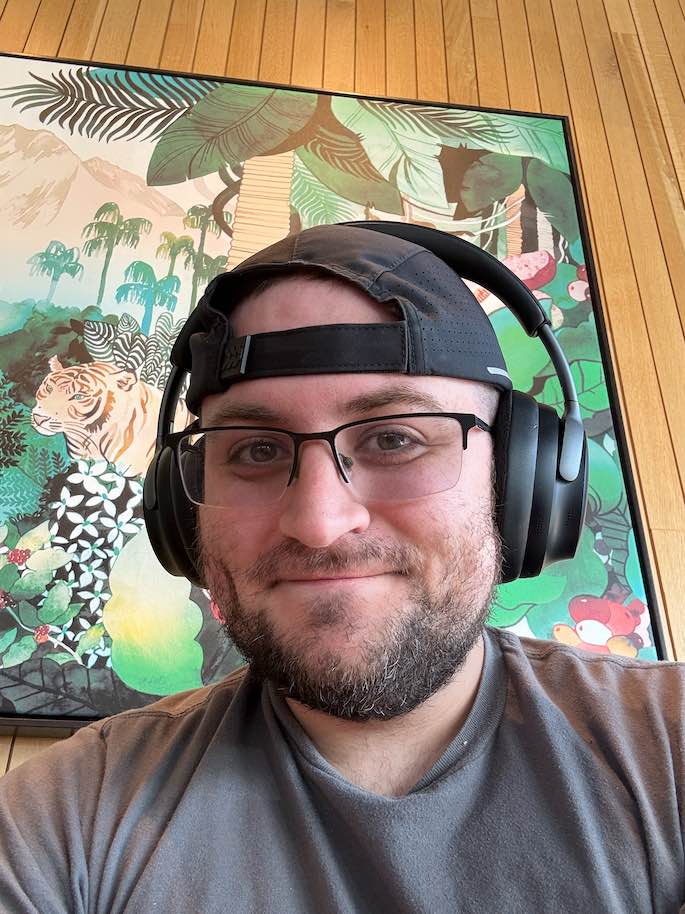
I spent the first thirty years of my life thinking I was intelligent but fundamentally broken.
I'm Andrew Purdum, the creator of Do More In A Day. I had ideas. I had capability. I had, according to everyone around me, "so much potential." What I didn't have was a reliable way to translate any of that into actual output on a regular Tuesday.
I'd have brilliant weeks followed by weeks where I couldn't make myself send a single email. I'd build elaborate systems on Sunday night and abandon them by Wednesday. I'd sit at my desk for three hours and produce forty-five minutes of work, then spend the rest of the time managing the shame of the gap.
I was diagnosed with ADHD at 27. And then I did what a lot of people do after a late diagnosis: I went looking for the manual. The one that explained how to actually operate this brain. I read the neuroscience. I worked with specialists. I tested everything I could find that was built specifically for neurodivergent executive function — not adapted from neurotypical productivity, but built from scratch for this specific wiring.
Do More In A Day is that manual. It's what I built out of everything that actually worked — distilled, structured, and priced so that the version of me from five years ago could have accessed it without a second thought.
I'm not a productivity guru. I'm someone who figured out how to work with a brain like yours, and built a system out of it.
Everything you get
when you join today.
One complete system. Built for how your brain actually works.
I want to say something about that number before you decide.
You've probably spent more than $27 on productivity solutions that didn't work. The planner you used for two weeks. The app subscription you forgot to cancel. The book you read half of. The course you bought during a good week and never opened. I'm not saying that to make you feel bad — I'm saying it because the framing matters.
Twenty-seven dollars is not a bargain price on a thing with a real retail value of $297. I don't do that math. Twenty-seven dollars is the price I set because I wanted the version of me from five years ago — exhausted, skeptical, protecting himself from another failure — to be able to say yes without it being a financial decision.
This is not a discounted course. It's a $27 course. The price reflects a choice about access, not a judgment about value.
What it costs if it works: $27.
What it costs if it doesn't: $27, and you get that back.
What it costs to keep doing what you're doing: that's the number I'd actually think about.
If you go through the material and it doesn't work for you, email me within 30 days and I'll refund every dollar. No forms. No hoops. No questions designed to make you feel bad for asking. The risk is entirely mine.
$27 · Instant access · 30-day guarantee
You've been sitting with this long enough. Here's the quiet, clear version:
Your brain is not broken.
It just needs a different operating system.
This is it.
What You're Getting
Do More In A Day
Complete Masterclass + Bonuses
You'll have Module 1 and the Morning Protocol in your hands within the next three minutes. You can start tonight. You can start tomorrow morning. You can start on the next Tuesday that feels like every other Tuesday — except this time, you'll have a sequence.
However, I have to warn you. We're testing this low introductory price at $27 for a limited time - but in the very near future the price will increase to $67. This means you're getting a huge savings of $40 when you get "Do More In A Day" today.
You don't have to believe it will work.
You just have to be willing to find out.
If you've read this far, I want you to know something.
The fact that you're still here — still reading, still looking, still trying to find the thing that will finally work — is not evidence of desperation. It's evidence of persistence. Of a person who hasn't given up on themselves, even when giving up would have been the easier choice.
That matters. Whatever you decide today, that matters.
You've been carrying something heavy for a long time. I hope this is the thing that makes it lighter.
Start today — for
$27.
One payment. Instant access. Built for the brain you actually have.